
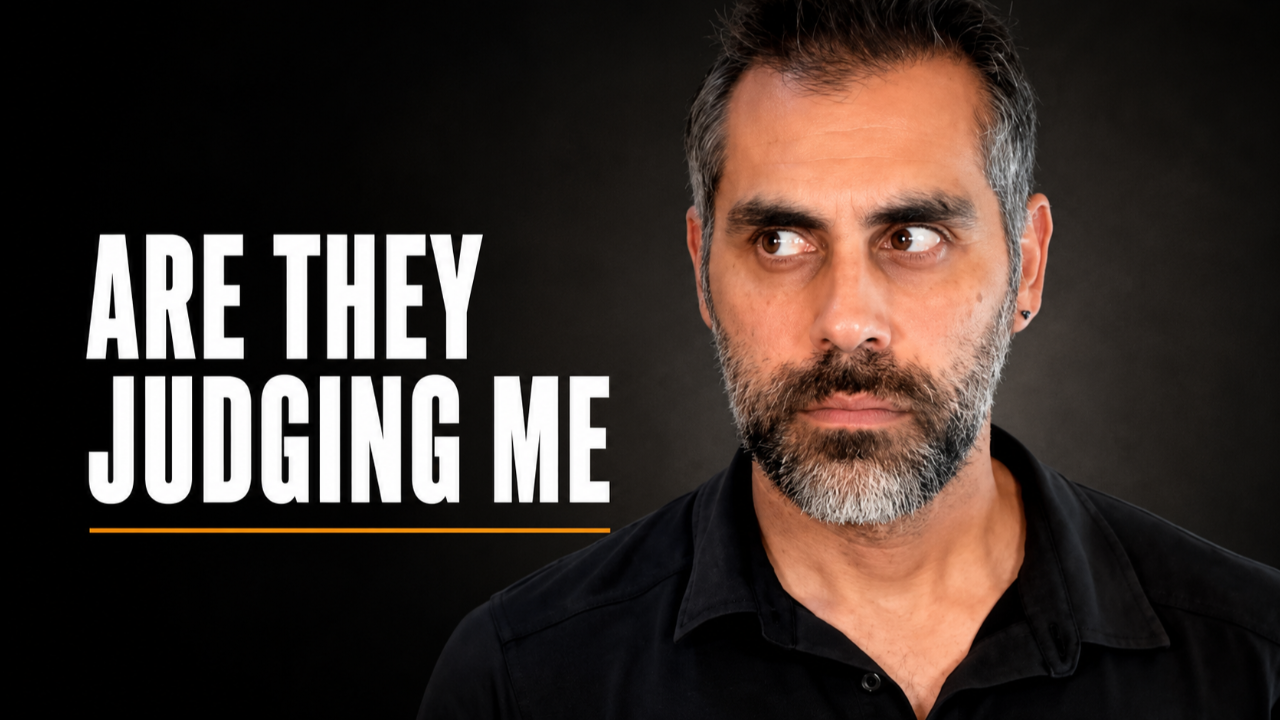
Why You Can't Stop Caring What People Think
Jun 02, 2026
You've probably tried to quit social media. Made a thing of it. Uninstalled the apps. Told a few friends you were getting off the sauce.
Then a day later, you're on a hike, the light is hitting just right, and you take a photo. I'll just post this one. Reinstall, post, put the phone away. An hour later, you're checking it. Not the photo. The thing beneath the photo. The likes. The hearts. The comments. The number.
If the number hits some private threshold you've never said out loud, you feel a small lift. If it doesn't, something deflates. Nobody likes it. I'm pathetic. Why did I post that.
You've probably called this comparison anxiety. Or social media addiction. Or I just need to care less what people think. Maybe you've blamed yourself for being too sensitive, too needy, too wired-in to other people's reactions. The labels describe what's happening. None of them explain why it doesn't move when you decide to stop, or why uninstalling the apps doesn't make the deflation go away.
This isn't a personality flaw. It isn't weakness. It's the operating system of the world you've been living in for the last twenty years, and even if you uninstall the apps tomorrow, the equation is already installed.
Why Caring What People Think Got So Much Worse
There's a reason this hit us all at once. It has a name.
The approval economy is the cultural arrangement we've ended up with where approval has become the visible, measurable, primary currency of being a person. It didn't start with social media. Social media just industrialized it.
Go back far enough and approval was local. Your family, your community, the people at work, the people at church or temple, your neighbors, your friends. That was the audience. There were maybe fifty to a hundred people whose approval mattered to your sense of okay-ness, and most of them you saw regularly. Visible, measurable, ranked approval was a thing that happened to other people. Celebrities. Politicians.
I remember being a kid in the eighties and walking past the magazine rack at the supermarket. Tabloids on display. Michael Jackson is a saint. The next week: Michael Jackson is a monster. And we'd eat the popcorn and watch the lifting up and the tearing down, and it was entertainment. It happened over there. Separate from us.
That separation is gone.
It went in stages. Cable TV in the eighties. The internet in the nineties. Then YouTube and Facebook in the early 2000s, and the architecture of the world quietly inverted. Suddenly anyone could publish, and everything anyone published could be measured. Thumbs up. Hearts. Stars. Comments. Counts. Originally YouTube had a thumbs down too. They eventually pulled it, presumably because the thumbs down number was its own minor mental health crisis.
Now look around. Everything is rated. Books on Amazon. Audiobooks. Restaurants. Doctors. Driver. Passenger. Yelp. Glassdoor. Goodreads. The dentist. There's probably a rating system being designed somewhere right now for first dates. He's a 3.8. I think I'll wait for a 4.7. There's one guy with five stars but he only has one review and it's clearly his cousin. It's only a matter of time.
This is what I mean by the approval economy. The currency of the world has quietly become approval, and we are living inside the trading floor. So when you ask why you can't stop caring what people think, the most accurate answer isn't because something is wrong with you. It's because you grew up inside a system that rewarded the caring at every turn.
The Moment It Got Installed in Me
I want to tell you a specific story, because I think it'll be familiar.
I was about eleven or twelve. I was waiting for a haircut at a Supercuts. There was a magazine on the bench. Us Weekly, I think. I'd never read anything like it before, but I picked it up and started flipping through.
I landed on a full-page ad. The design was a strip torn out of the page, exposing only a woman's eyes. Above the strip, three words.
Tired of raccoon eyes?
Below the strip was the cream they were selling. The cream that would make those horrible, gross dark circles disappear.
My dad is from Pakistan. People from that part of the world commonly have darker pigmentation around the eyes. It's not a flaw. It's not a problem. It's just how a huge percentage of the human population looks. I'd never thought about it once in my life until I sat in that Supercuts.
I didn't articulate the thought consciously. It went straight in. The conclusion was pre-verbal: I'm ugly. I'm undesirable. I'm unworthy of love and connection.
I was eleven. I was just starting to wonder whether I was attractive to anyone. The magazine had a clear answer. No. And here's a cream that might fix it.
Now go get your haircut.
That was one ad. One page. Pre-internet. I want you to imagine what's happening to a fifteen-year-old today, scrolling for two hours on apps engineered by some of the smartest behavioral scientists in the world to maximize engagement through exactly the same emotional mechanism. Ten thousand small ratings of what you're supposed to want to be. Each one tiny. The aggregate effect is not tiny.
This is the water we're swimming in. By the time you're an adult, the equation has been written so many times you read it as your own thinking.
The Equation Underneath All of It
Here's the equation. It's worth reading slowly.
Approval doesn't just equal approval. Approval equals worth.
That second equals sign is the entire problem.
Approval at the local level, in normal human-scale relationships, is information. It tells you something about how a particular person is responding to you in a particular moment. That's useful. You should pay some attention to it. It is not, and never was, a measure of your value as a human being.
The approval economy collapses that distinction. Now the number under the photo isn't information about how the algorithm distributed your post. It's a verdict. The lack of a reply isn't a logistical fact about that person's day. It's a verdict. The way the room reacts when you speak isn't useful data about the topic. It's a verdict on you.
Worth, in the approval economy, is something other people get to vote on.
This is the actual mechanism underneath what you've been calling comparison anxiety or low self-esteem or I just need more confidence. You're not low in some self-worth resource. You've been trained, by repeated exposure, to outsource the calculation of your worth to whoever happens to be looking at you in a given moment. The math is delegated. You feel the result.
I want to show you how deep this goes. The other day my kids were playing in the house. Little basketball hoop, foam ball, dunk contest. One of them said let's film you dunking and post it. They filmed it. The punchline they came up with, the joke they were both already laughing at before the bit even landed, was: and it gets no views.
A video getting no views. That's so pathetic.
They're ten and twelve.
They have already absorbed, without anyone teaching it to them explicitly, that a video with no views has no value, that a video with more views has more value, and by extension that a person with more visibility has more worth. They didn't get this from a particular bad parenting moment. They got it from breathing the air.
If your nervous system feels deflated when a post underperforms, you didn't fail at being above this. You're a normal human living in a culture that systematically trains the deflation response. The shame people feel about the shame is its own loop. I shouldn't care this much. Why do I care this much. There must be something wrong with me that I care this much. No. There's something thoroughly normal about you, in a thoroughly weird situation.
If this is starting to land, the 2-minute quiz at draziz.com maps the specific way the approval economy has shaped your behavior — what's underneath what you've been calling people-pleasing, social anxiety, or chronic comparison. There are four patterns. Most people don't know which one is theirs until they see it.
Why You Can't Just Stop Caring
The approval economy installs the equation. The approval trap is what you do once it's installed.
You go through your day. Work, social, dating, family. Ostensibly you're there to do something. Have the conversation. Make the decision. Connect with the person. Share the idea.
But underneath, that isn't actually your top priority. Your top priority is to maintain approval, and even more than that, to avoid disapproval. Because the nervous system always wants to avoid threat more than it wants to chase reward.
This means almost no one I work with is showing up to a meeting trying to dazzle the room. The internal monologue is much more often: Don't look at me. Don't say anything stupid. Don't mess this up. Just get through this.
That's the actual phenomenology of most professional life for most thoughtful people. Not a song and dance. A long internal exercise in damage control.
So you go through your day being a partial version of yourself. You hold things back. You soften what you wanted to say. You avoid the conversation that needs to happen. You don't ask for what you actually need. You don't say no. You don't have the boundary. You don't share the thing that's interesting to you because some part of you has already calculated that the share might land badly.
This is the trap. And the cleverest thing about it is that you don't experience it as a trap. You experience it as being a reasonable person.
Why Quitting Social Media Doesn't Fix It
The hardest part of all this is that the policing isn't coming from outside.
If the approval economy were only external, you could log off, move to a small town, ignore the comments section, and be free. People do this. It helps. It does not, on its own, solve the problem.
The reason is that the biggest enforcer of the approval economy isn't the algorithm. It's the version of you that has been trained on the algorithm for two decades. The internal voice that evaluates every email before you send it. That replays the meeting an hour later asking what people thought. That scans every social interaction for the subtle frowns and pauses that might mean disapproval. That lies awake the night before a presentation rehearsing what you'd say if it went badly.
You're chronically self-evaluating. Was that okay. Is this enough. Will this get approval. Will this get disapproved of. The dial is turned up the closer you get to anything that feels exposed. By the time you're about to give a talk, ask someone out, send a difficult message, the self-evaluation is so loud it drowns out the actual content of what you wanted to do.
You can uninstall the apps. You cannot uninstall the version of yourself the apps trained.
This is also why the standard advice — just stop caring what people think, just be more confident, just remember nobody's actually paying attention — never moves the needle. It's like telling a smoke alarm to stop being so jumpy. The alarm isn't the problem. The wiring underneath is. And the wiring isn't going to update because you read another book about not needing external validation.
That doesn't mean you're stuck with it forever. It means the work isn't on the surface. You're not going to fix this with better discipline around your phone, or better mindset techniques, or another article about boundaries. The equation goes deeper than any of those.
What Most People Miss
Most people who recognize themselves in this don't have a confidence problem. They have a specific, predictable response to being raised inside an approval economy. There are four of them. The pattern you run depends on what your particular nervous system learned worked best at avoiding disapproval, somewhere between the ages of zero and fifteen, in the specific environment you grew up in.
Some people learned to soften and smooth — what gets called people-pleasing or being too nice. Others learned to disappear from anything risky — what gets called shyness or social anxiety. Others learned to manage everyone else's emotions so no one would ever be upset — the over-caretaker, the codependent, the burnt-out empath. Others learned to perform their way to safety by being impressive enough that no one could reject them — the perfectionist, the high-achiever, the one with imposter syndrome.
These are not personality traits. They are not who you are. They are well-trained nervous-system responses to a world that taught you, very early, that approval equals worth. Each one comes from the same equation. Each one runs differently.
The first move out of the approval trap isn't to stop caring what people think. That's not a real instruction. The taste buds for approval don't go away because you decided they should. The first move is to see, with clarity, the specific water you've been swimming in. To recognize that the cultural arrangement is not normal in any historical sense. That the equation got installed. That you didn't choose it. And that what feels like a personal flaw — the comparison, the self-policing, the scanning for disapproval — is, in most cases, a thoroughly predictable response to the environment.
Once you can see that, the version of you that's been chronically self-policing starts to relax. Not all at once. But the grip starts to loosen. The internal voice that evaluates everything you do starts to sound less like the truth and more like one specific cultural script that you happened to be trained on.
That's the beginning. The rest is figuring out which of the four patterns is yours, and what specifically to do about it.
You weren't broken. You were swimming.
Discover your approval type — take the 2-minute quiz at www.draziz.com
You'll find out which of the four patterns the approval economy installed in you — what's underneath what you've been calling comparison anxiety, people-pleasing, or just I care too
Reading blogs and watching videos online is a start...
When you are ready to radically transform your confidence so you speak up freely, boldly go after what you want, connect easily with others and be 100% unapologetically yourself, coaching is the answer.

GET YOUR FREE CONFIDENCE MINI-COURSE NOW!
Unleash Your Inner Confidence Today!
Click On The Button Below To Get Your FREE Mini-Course Right Now!
GOT CONFIDENCE?

Confidence University is the culmination of all my years of work assisting others with overcoming social anxiety and building unstoppable confidence in its place. It's the next best thing to work with me one-on-one.