
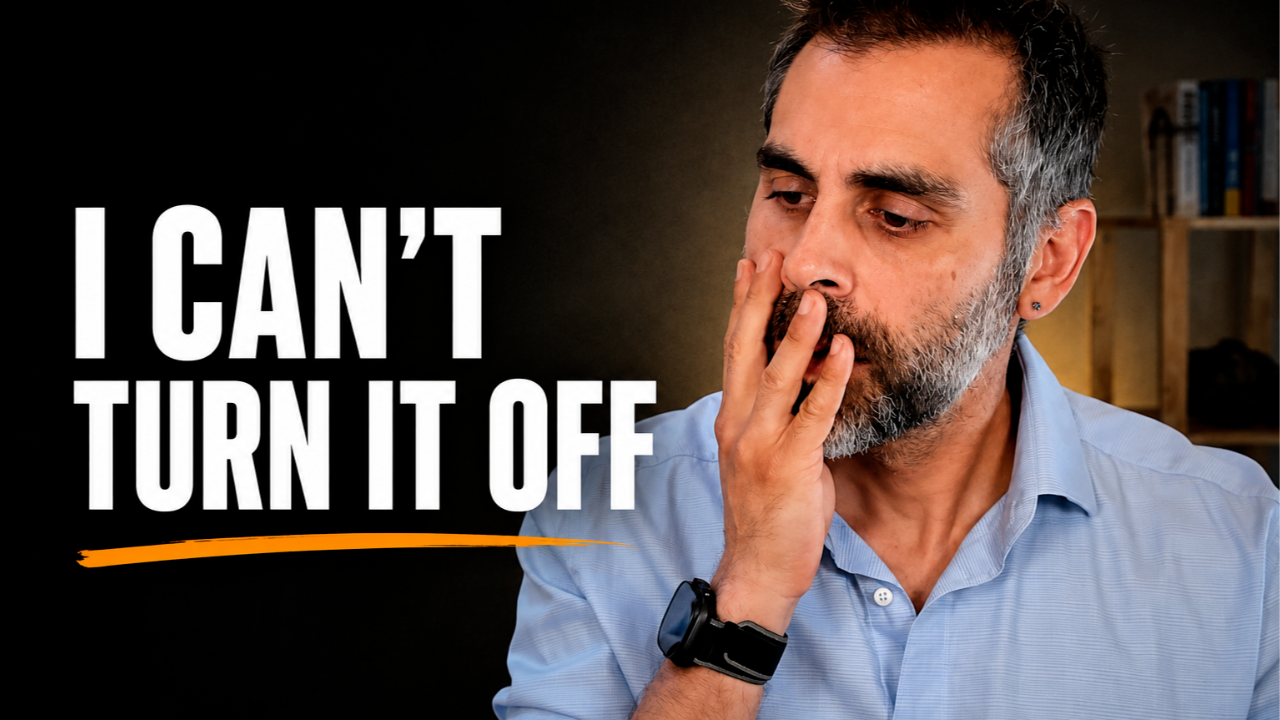
Why You Can't Stop Performing (Even When It's Exhausting You)
Jun 30, 2026You're successful by every external measure. The career is real. The resume is real. The credentials, the income, the achievements - all real.
You're also exhausted in a way that doesn't show up in any of that.
Some part of you, much of the time, is tracking how you're coming across. Real-time. Confident enough. Smart enough. Polished enough. You walk into the meeting and the inner observer activates before you've taken your first breath. Watching you. Adjusting you. Asking whether that came out right. Asking what their face is doing. Asking why the executive on the left looked away when you said that thing.
You've probably called this perfectionism. Or imposter syndrome. Or high-functioning anxiety. Maybe a little performance anxiety. Or you've decided you're just driven, ambitious, high-standards. The labels are accurate as far as they go. They describe what's happening on the outside. They don't explain why it's getting worse instead of better, why the success hasn't fixed it, why fifteen years of credentials haven't translated into fifteen consecutive minutes of being able to relax inside your own life.
This isn't your personality. It's a specific pattern, and once you can see it, you can stop running it.
What the Performer Pattern Actually Is
When your nervous system reads disapproval as danger, it picks one of four strategies for keeping you safe. The one I'm describing here is the Performer. It's the most rewarded of the four patterns — the one that gets the promotions, the recognition, the she's so impressive reputation. It's also, in my experience, the most exhausting.
The Performer's logic is simple: if I'm impressive enough, they can't reject me.
So you optimize. The email gets read fifteen times before it gets sent. The presentation gets prepped to within an inch of its life. How you look, how you stand, the social charm you turn on when you walk into the room — all of it has a dial that goes from off to on, and you're rarely off. Even your depth has a dial. Some Performers don't manage charm or polish; they manage being deep, always pulling the conversation toward something profound enough that they can't be dismissed as superficial. Same pattern, different polish.
What's actually being managed isn't your performance. It's the risk that someone will see you as anything less than the version of you you've decided is acceptable. Disapproval, in the Performer's wiring, is danger. So you give them no edge. You give them nothing to disapprove of. You stay impressive. The inner observer keeps watch.
This is why the Performer pattern is so often invisible to the person running it. People who run this pattern usually don't think of themselves as people-pleasers. They think of themselves as ambitious. As high-standards. As professional. The pleasing happens through the polish, and the polish has been so thoroughly internalized that it doesn't feel like an act — it feels like just how I am. It isn't.
What Performance Anxiety Actually Does
Here's what the inner observer does in real time. You're in a meeting. You've prepared. You know the material. Then you stand up to speak, and an entirely different system activates — fast, loud, contradictory.
That came out wrong. Why did you say that. Look at her face. They're not buying it. Recover. Say something better. Don't say um. Smile. Not too much. Too late, you said um again. They noticed.
You're trying to do the thing. The voice is steering. You can't think because you're being commentated on by yourself in real time. Get out of my head, part of you thinks. I can't even hear myself. But the voice is louder than the thinking-mind, because the voice is wired into your nervous system at a deeper level than your conscious thought.
This is what performance anxiety actually is. Not a fear of public speaking. A hyper-observation pattern that fires whenever the stakes feel high enough that disapproval feels possible. It happens in meetings. It happens in social situations. It happens on dates. It happens at family dinners with people you've known for thirty years. It happens reading texts before you send them.
If you've ever felt like you couldn't quite be in a room because you were too busy watching yourself in the room, this is what was happening.
Why Succeeding Doesn't Fix It
Most people who recognize the Performer in themselves try to fix it the same way: I'll get good enough that the doubt has to quiet.
So they perform harder. Prepare longer. Pursue more credentials. Climb higher. By any external measure, they succeed. And the voice is still there.
Here's why. The Performer's deal with itself is that no disapproval is the goal. Not approval. Not enough approval. No disapproval. Zero. From anyone. Anywhere. So you give the talk and ten people give you a standing ovation, and one person on the left looks at their phone, and you walk out worrying about that person. Why didn't they like it. What did I do wrong. Should I have phrased that differently. The standing ovation gets discarded as data. The phone-checker becomes the entire afternoon.
This is structurally impossible to win. There will always be a phone-checker. A skeptic. A bored face. An ambivalent reaction. So your worth, your sense of safety, your value as a person gets plugged into the next performance. And the next one. And the next.
Eventually everything becomes a performance. Work is a performance. Meetings are a performance. Dating is a performance. Socializing is a performance. For some Performers it's localized to certain domains. For most of the people I work with, by the time they reach me, it's gotten everywhere. Life is a performance. And the success they thought would quiet the voice has just given the voice more material to manage.
The Cost You're Probably Not Adding Up
The pure exhaustion is the cost you can feel. There are three more that compound underneath.
The first is the intimacy cost. You can't get close to someone you're performing for. The performance creates the distance. The people who love you don't quite know you, because the version of you they're loving is the polished one. There's a mounting fear underneath that — if they ever see the real, not-on me, this whole thing falls apart — and the fear forces more performance, which forces more distance, which forces more fear. The loop tightens over time. Some Performers end relationships in the early months for this reason. The thought of being seen for an extended period without the mask is more terrifying than ending the relationship.
The second is the joy cost. You don't get to enjoy what you've built. You got the relationship, but you can't relax into it. You got the career, but you can't savor it. You got the recognition, but you can't take it in. You're at best getting through the next performance. Until the next one. Until the next.
Imagine a Broadway show where you have a performance every hour, on the hour, forever. Maybe the role itself was once your dream. Now you do it twenty-four times a day in shifts and the dream has become its own kind of prison. That's what the Performer's life feels like from the inside.
The third is the identity cost. After enough years, some part of you stops being able to tell what's the performance and what's the actual you. You know what you're supposed to want, what you're supposed to find funny, what you're supposed to feel passionate about. The script has internalized. The author of the script — the original you who had unmanaged preferences and unsanded edges — is somewhere underneath, hard to find.
If this is starting to land, the 2-minute quiz at draziz.com maps the specific pattern you run. The Performer is one of four. Most people running this pattern don't see themselves as people-pleasers, which is why a quiz that names the underlying mechanism does work that am I a people-pleaser self-assessments don't.
The Story I Hadn't Told Until I Wrote My First Book
I want to tell you about a moment that changed how I understood what this pattern was actually doing to me.
I was in my twenties. Years into running the Performer hard. I was on a picnic in a park with a woman who, by every measure I'd previously thought I cared about, was someone I should have been delighted to be with. She was beautiful. She was smart. She was warm. She liked me. She wanted to spend the day with me. She wanted to spend the night with me.
If you'd asked me a year earlier whether I would have wanted that exact afternoon, I would have said yes without thinking. It was the thing I thought I'd been working toward.
What actually happened on that picnic was a panic attack.
I didn't know it at the time. I just knew that my vision was blurring, my body was screaming, I felt completely outside myself, and I had to get away. I made up something about needing to find a bathroom. The bathrooms were on the far side of the park. I walked there slowly, trying to pull myself together. I went in. I came back out. I paced.
I remember standing in the parking lot, genuinely considering whether I could just leave. Take my car. Run into the woods. Disappear. I had driven her there. I had no exit that wasn't humiliating. So eventually I walked back. I put the mask on. I got through the rest of the day.
I write about this in my book Not Nice. What was happening, I now understand, was that the version of me that this woman was seeing was the performed version. The polished version. The one I had spent years building so that someone exactly like her might want to spend a day with me. And the performed version had succeeded. She was here. The problem was that some part of me knew, on some level, that she was here for the performance - and that an entire afternoon of unscripted closeness with a real person was going to require dropping the performance, and that dropping the performance was going to be the death of everything I'd built.
The panic attack was my nervous system saying it could not sustain the performance for an entire day.
That moment, more than anything else, was what eventually turned me toward the work I do now. Not because I wanted to fix the panic. Because I realized that the version of success I'd been chasing was the kind that didn't include me. I'd been building a life I couldn't actually be in.
What Most People Miss
The Performer doesn't go away because you decided to just be yourself. You've tried that. Probably many times. In the bedroom the night before, lying awake, you've decided that tomorrow you'll be more relaxed, more authentic, less performative. And then tomorrow comes and you walk into the meeting and the buttoned-up version takes over before you've registered the change.
Willpower can't reach this for the same reason it can't reach the Diplomat or the Avoider or the Fixer. The Performer is a survival strategy that's been running for thirty or forty years, wired into your nervous system at a level that's faster than your conscious thought. Telling yourself to just be more authentic doesn't tell your nervous system anything it can use. It's like telling a smoke alarm to stop being so jumpy. The alarm isn't the problem. The wiring underneath is.
What changes the pattern is systematic training of the actual nervous system. A combination of action, exposure, and the slow reclamation of a sense of safety from the inside instead of from the polish you've been generating to manage other people's reactions. This isn't a mindset shift. It's a rewiring. And it's possible - not slowly over decades, but real change in months - when you can see the pattern clearly enough to stop treating it as your personality and start treating it as something you can actually shift.
The version of you that doesn't need to perform isn't a fantasy version waiting on the other side of more achievement. It's the version that's underneath all the performance, the one who hasn't gotten to come out and play in fifteen or twenty years because there's been a show running every hour on the hour.
The show can stop. Not all at once. Over time, in real reps, in actual situations where your nervous system gets to discover that not performing didn't kill you. Each rep is a small piece of the rewiring. The reps add up.
You weren't supposed to be the Performer forever. That part wasn't who you are. It was who your nervous system thought you needed to become to stay loved. You don't.
Discover your approval type - take the 2-minute quiz at www.draziz.com
The Performer is one of four. You'll find out which pattern is running underneath what you've been calling perfectionism, imposter syndrome, or high-functioning anxiety, how it shows up in your work and your relationships, and what actually shifts when you stop trying to fix it from the surface.
Reading blogs and watching videos online is a start...
When you are ready to radically transform your confidence so you speak up freely, boldly go after what you want, connect easily with others and be 100% unapologetically yourself, coaching is the answer.


GET YOUR FREE CONFIDENCE MINI-COURSE NOW!
Unleash Your Inner Confidence Today!
Click On The Button Below To Get Your FREE Mini-Course Right Now!
GOT CONFIDENCE?

Confidence University is the culmination of all my years of work assisting others with overcoming social anxiety and building unstoppable confidence in its place. It's the next best thing to work with me one-on-one.