
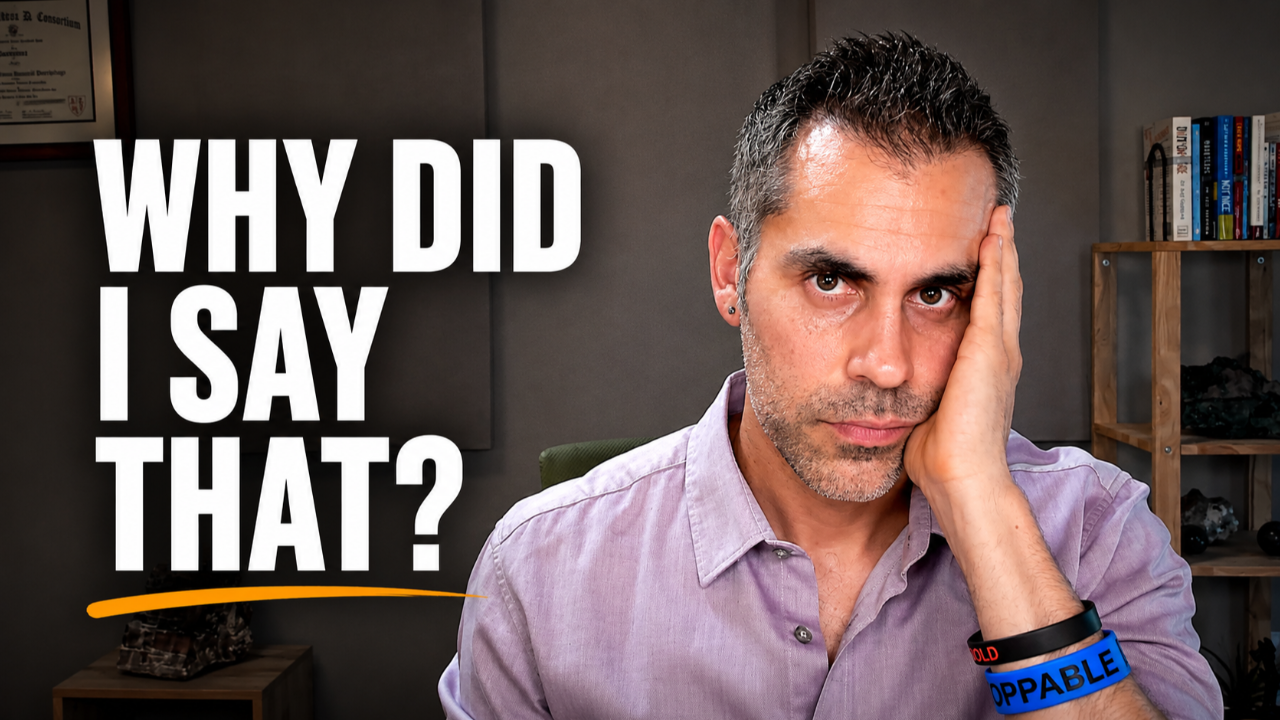
Why You Can't Stop Replaying That Conversation
Oct 06, 2026
You had a conversation.
Maybe hours ago. Maybe days ago. Maybe three weeks ago. Or two years ago, and you're still holding it.
You're running it back. What they said. What you should have said. The perfect line that came to you in the car afterward, that you're still practicing in your head as if you'll get another chance to deliver it. The one word you wish you'd landed on. The moment when the whole thing turned and you didn't quite catch it.
You've probably tried to just forget it. That hasn't worked. You've told yourself to let it go. That hasn't worked either. Time isn't dissolving it. And you can't figure out why your brain won't cooperate.
The reason your brain won't let it go isn't a bug. It's a feature. The replaying is a signal, and the signal is trying to give you something you need.
The Signal Is About Something Unsaid
Here's what's actually happening.
When a conversation keeps looping in your head, it's almost always because there was something unsaid. Something that needed to be communicated in that moment, and you didn't communicate it. You didn't stand up for yourself. You didn't ask for what you wanted. You didn't hold the boundary. You didn't voice the disagreement. You didn't name the hurt.
The conversation is unfinished business. And your brain is trying, over and over, to complete it.
Most people miss this because they interpret the replaying as their mind searching for the perfect line. If only I'd said this. If only I'd thought of that. In the Seinfeld sense: the jerk store, called. They're running out of you. That's George's obsession in a whole episode, and it captures how most of us relate to the replay. We're trying to construct the perfect zinger we should have delivered.
But the replaying isn't about the zinger. Even if you'd delivered the perfect line, if the underlying thing you needed to say went unsaid, the loop would still run. Because the thing that needed to come out wasn't a comeback. It was a truth. And truths don't get resolved by being retrospectively perfected. They get resolved by being met.
The Questions That Reveal What Was Left Unsaid
If a conversation is looping and you can't quite put your finger on what was unsaid, here are the questions that open it up. Ask them slowly. Give yourself real answers.
What am I actually feeling about it? Not the surface. Underneath. Am I angry? Resentful? Frustrated? Am I hurt? Am I feeling pressured or violated in some subtle way? People often skip past hurt because it feels vulnerable, but hurt is one of the most common unsaid things behind a looping conversation.
What did I like or dislike about what they said? Get specific. Which sentence bothered you? Which tone shift landed wrong? Which assumption in what they said felt off?
What would I have preferred? This is the key question. If you could have written the ideal version of how they approached you or what they said, what would it have been? The answer to this question is often exactly what you needed to communicate but didn't.
The point of these questions isn't to blame yourself for not saying the thing in the moment. The point is to hear the signal your brain has been trying to deliver. Once you can hear it clearly, the replaying starts to lose its grip. It doesn't need to keep looping. You got the message.
Where Most People Undermine Themselves
Here's the move that stops the whole practice cold, and I did it to myself for years.
You identify the thing that was unsaid. I was hurt by the way they said that. I wish they hadn't dismissed me. I would have wanted to tell them to stop pressuring me. Real information. Useful information.
And then, immediately, you turn on yourself. You're too sensitive. You're being a weenie. You can't take a joke. Why didn't you just handle it? Everyone else would have been fine with that. You're weak.
Three words. You're too sensitive. And the whole thing collapses.
You've just done to yourself what you were afraid the other person might have done to you. You threw the key in the dirt and stepped on it. Now the signal has been dismissed by the one voice that had the power to hear it. Which means the loop has to keep running, because the message never landed.
If you've been running self-criticism as your response to the replaying, this is why the replaying hasn't stopped. You're actively blocking the process that would put it down.
Listen the Way You'd Listen to Someone You Love
Here's the alternative move.
Imagine a friend told you what you just told yourself. I had this conversation two weeks ago. I'm still bothered by it. I think what they said was inappropriate, but I feel bad for feeling hurt about it. I'm probably being too sensitive.
Would you tell them they're being too sensitive? Would you tell them to just get over it? Would you dismiss the hurt?
You wouldn't. You'd listen. You'd validate the hurt. You'd say yeah, that does sound like something worth being bothered by. That was kind of a rude thing to say. I get why that's stuck with you.
That's the tone you need to bring to yourself when you're processing what a looping conversation is trying to tell you. Not criticism. Not correction. Not the inner drill sergeant telling you to toughen up. Actual receiving. The same warmth you'd bring to someone you love who was going through the exact same thing.
This is what I call being on your own side. It's not self-indulgence. It's the specific stance that makes it possible to actually process what happened and integrate the learning.
The Commitment Underneath
Once you've received the signal, there's one more piece.
Part of the reason your brain keeps replaying is that some part of you is scared that you won't do anything different next time. That you'll let the same thing happen again. That you'll go quiet in the next conversation where speaking up would matter. So it keeps replaying, hoping that if it makes you feel bad enough, maybe you'll finally act differently.
That's why the loop doesn't stop when you just recognize what was unsaid. It stops when you make a specific commitment about what you'll do differently.
Not vague resolve. Specific commitment. The next time someone pushes on me after I've said no, I'm going to say: I know you're passionate about this, but I've said no three times and it's starting to feel like pressure. That specific. That practiced.
Then, ideally, you say it out loud. Right now. In the room you're in. To an empty chair if you want to imagine the person is there. You give the response you didn't give in the original moment. You say it with all the clarity and firmness that was needed.
I know this sounds a little unusual. There are entire schools of therapy built on this practice. It's called unfinished business. People talking to empty chairs. It works because the thing your nervous system needed was expression. Expression to yourself, to the room, to the imagined other person, is still expression. It counts.
What Actually Puts the Conversation Down for Good
The pattern that determines which conversations loop and how long they loop is one of four. The specific version of it you're running determines how the practice will look in your case.
Across all four, the fundamental sequence is the same:
- Notice the conversation looping.
- Ask what was unsaid.
- Receive the answer without self-criticism.
- Say it out loud, to yourself or to an empty chair.
- Make a specific commitment about what you'll do differently next time.
- Follow through on the commitment in the next real situation.
That last step matters. The best way to stop replaying conversations is to actually say the thing in future conversations. The loop stops because there's no more unfinished business to complete. The moment your nervous system starts trusting that you'll speak up next time, the replaying serves no function. It stops on its own.
What Most People Miss
The replaying isn't the problem. It's the messenger.
Trying to force yourself to stop replaying is like shooting the messenger for delivering news you didn't want to hear. The replaying will stop when you receive what it's carrying, honor the truth of what needed to be said, and commit to being the version of yourself that says it next time.
The conversation you can't stop replaying is trying to make you into someone who would have handled it differently. The way to honor that is not to feel bad about who you were in the original moment. It's to become the person the replaying is trying to shape you into. That person, at some point in the near future, will handle the conversation the loop has been asking for. And the loops will stop.
Discover your approval type. Take the 2-minute quiz at www.draziz.com
The pattern that determines which conversations you replay and how long they run is one of four. You'll find out which is yours, how it has been shaping the specific things that get left unsaid in your life, and what the practice looks like from where you are now.
Reading blogs and watching videos online is a start...
When you are ready to radically transform your confidence so you speak up freely, boldly go after what you want, connect easily with others and be 100% unapologetically yourself, coaching is the answer.


GET YOUR FREE CONFIDENCE MINI-COURSE NOW!
Unleash Your Inner Confidence Today!
Click On The Button Below To Get Your FREE Mini-Course Right Now!
GOT CONFIDENCE?

Confidence University is the culmination of all my years of work assisting others with overcoming social anxiety and building unstoppable confidence in its place. It's the next best thing to work with me one-on-one.