
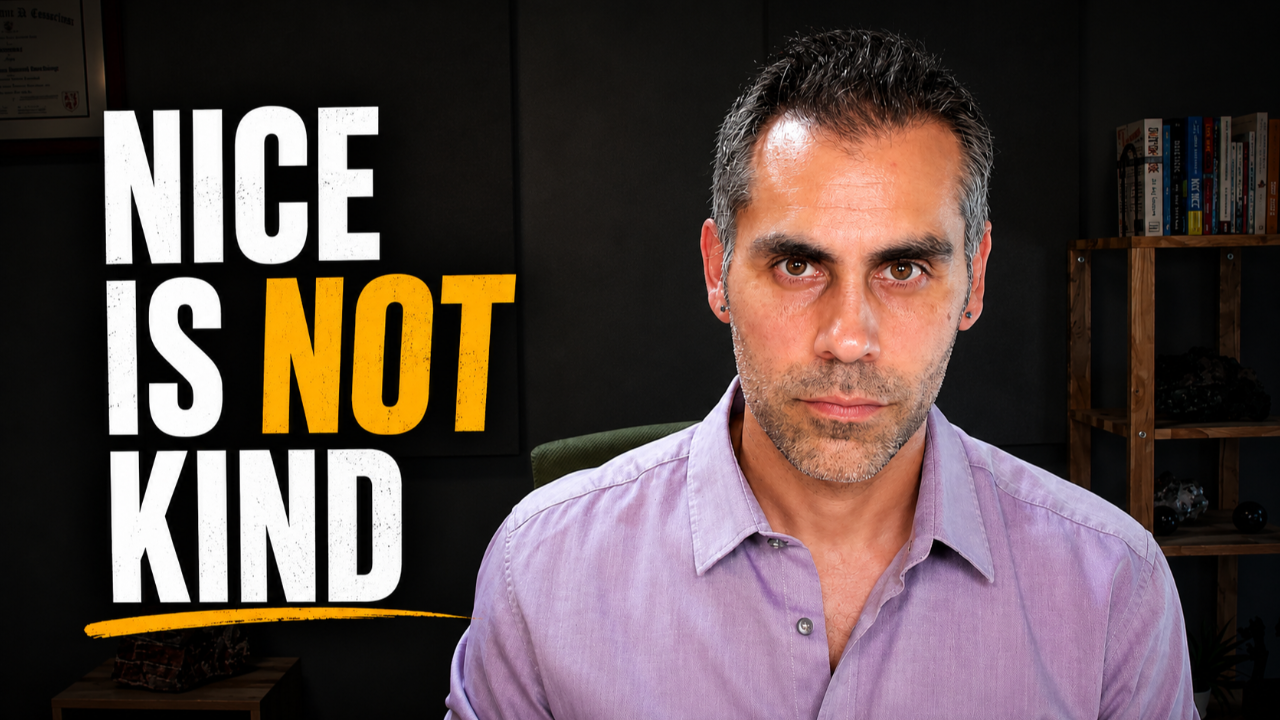
The Hidden Fear Behind Being Nice
Oct 14, 2026
You take some quiet satisfaction in being one of the good guys.
You give. You show up. You say yes when you want to say no. You take on the extra thing. You do the thoughtful gesture. You're not out there hurting people, taking advantage of anyone, or moving through life at other people's expense. That's what other people do. You're one of the kind ones.
There is nothing wrong with any of that, if it's actually kindness.
Most of the professionals I work with haven't looked closely at what's running underneath their yes. They've assumed it's kindness because it comes out looking like kindness. They've assumed it's generosity because generous is what other people call them for it. They've built an identity around being the person you can count on.
And then, somewhere in their thirties or forties, they notice they're exhausted. They notice they're resentful in ways that don't quite line up with the story they've been telling themselves. They notice they can't remember the last time they said no to anything without a knot in their stomach.
If that's you, this is what's actually happening.
The Tell Isn't the Yes
Almost every conversation I have about people-pleasing gets stuck on the same wrong question. Is it kind to say yes here, or should I say no? People turn it into a moral question. They evaluate their own generosity like they're grading a paper. They wonder if they're being selfish.
That's the wrong frame entirely.
The question isn't whether the yes was correct. The question is whether the yes was actually kindness or something dressed up to look like kindness. And the tell isn't in the yes itself. The tell is in what the yes leaves behind.
Real kindness leaves an afterglow.
You extend yourself for someone. Maybe you even push through some discomfort to do it. And afterward, you feel warm. There's a sense of connection. You're glad you did it. You'd do it again. The extension cost you something, and the cost was worth it, and you're not carrying it around as an unresolved thing days later.
Fear dressed up as kindness leaves something completely different behind. Fatigue. Irritability. A specific low-grade resentment that you might not even name that way. A desire to withdraw from the person you just helped. A slow buildup of the sense that you're being taken advantage of, or that no one appreciates you, or that if you have to do one more thing you might snap.
If your yeses are leaving that behind, the yes wasn't kindness. It was fear.
Which changes everything about the diagnosis.
The Wild West Stick-Up
Let me give you a metaphor that I use with clients to describe what's actually happening in your nervous system in the moment when the request comes in.
Picture an old-fashioned Wild West bank. Small local branch, no vault-level security, no way to trace the money if it disappears. A masked stranger walks in. Pulls out a pistol. Says the line. Hands up. This is a stick-up.
What do the bank tellers do?
They put their hands up. They give the man the money. They comply. Immediately, completely, without asking follow-up questions. Not because they philosophically endorse the redistribution of wealth. Because they are afraid of dying.
That is exactly the energy running when a nice person says yes to a request they don't want to say yes to.
Someone says hey, I really need your help with this thing. Your body reads it as hands up. Your response comes out shaped by the same reflex the bank tellers had. Compliance without follow-up questions. Fear-based, immediate, self-abandoning.
You're not standing there rationally weighing whether to help. You're standing there instinctively trying to make the threat go away.
The threat, of course, isn't a bullet. The threat is disapproval. It's their disappointment. It's the potential judgment. It's the guilt you'd feel if you didn't do the thing, or the guilt you already start feeling before you even have a chance to consider whether the request is reasonable.
Once you can see the stick-up energy in your own yes, you can't unsee it. And you start to realize how many of your yeses over the years came from that same reflex.
The Reasons You Told Yourself
Watch what your mind offers as reasons when you're deciding whether to say yes to something you don't want to do.
They'll feel bad if I say no.
They'll feel like I don't care about them.
They have so much on their plate. I should just help.
It would be selfish of me to prioritize my own needs here.
I would feel so guilty if they looked at me disappointed.
They might get angry. They might retaliate. They might sabotage me at work.
Read through those slowly. Any of them sound like virtues?
They don't. They sound like fear. Fear of their reaction. Fear of your own guilt. Fear of their judgment. Fear of imagining your mother's judgment from thirty years ago, still running in the back of your mind. It's all fear. And out of the fear, you say yes.
For years I ran an especially confusing spiritual version of this pattern. I told myself I was the one without ego. I was the one who could give things away without being attached. I could handle the extra thing. I was the mature one. And underneath, quietly, I was resentful and disappointed I'd given the thing away, and there was no room in my own story to admit that.
That's what fear-dressed-as-kindness looks like when it gets sophisticated. It borrows spiritual language. It looks virtuous. It gets celebrated by the people around it. And it keeps the person running it deeply disconnected from what they actually want.
The MVP Question
Here's the question that started to break the spell for me, and that starts to break it for the clients I work with. I playfully call it the MVP question, from my book Not Nice.
What do I want here?
That's it. Four words.
I cannot tell you how many high-functioning, thoughtful, self-aware adults have never seriously asked themselves that question in the moment when a request comes in. Not because they're incapable. Because for their whole lives, some part of them has felt that asking the question is itself dangerous. Bad. Selfish. Ego-driven. Immature.
How dare you.
If you try to ask yourself what do I want here and you feel an immediate wave of how dare you, you have located the pattern. The pattern is exactly that. Your own preference has been categorized, somewhere in your nervous system, as something you don't have permission to consult.
Which means you've been running your life for years, maybe decades, from a starting point that never asks what you actually want. You've been calculating what other people want. You've been calculating what won't disappoint them. You've been calculating what will keep you safe from their disapproval. But your own preference has been quietly filtered out of the whole calculation.
The MVP question puts you back in the equation of your own life.
What Living This Way Actually Costs
The picture the nice-person pattern paints of itself is that it produces a beautiful, generous life full of loving relationships and good karma. That's the story the pattern tells about itself.
The actual accumulation looks different. Divorces that came out of nowhere because the accommodating spouse could never voice what they actually wanted. Career stagnation because they couldn't advocate for themselves in the meetings that would have moved them forward. Marriages that lasted but felt dead inside because one person had never risked disappointing the other with a real preference. Friendships that grew imbalanced and then quietly ended.
None of that came from selfishness. It came from the opposite. It came from a pattern that never let the person show up as a whole human with wants of their own.
The wreckage isn't dramatic. It's a slow, decades-long accumulation of a life that never quite got to be theirs.
What Actually Changes It
The specific version of this pattern you're running is one of four. Knowing which one you're running shapes what the shift looks like in your case.
Regardless of the specific version, insight is not enough on its own. I know a lot of people who have done a decade of therapy and can articulate exactly why they run the pattern and are still running it in every conversation. Understanding the mechanics does not update the nervous system. Only repeated experience does.
Which means the work isn't just to see the pattern. The work is to practice asking what do I want here in real situations. To let the answer land. To act on it, even when it feels wrong, because the right thing will feel wrong for a long time when you're doing something your nervous system has categorized as dangerous.
What Most People Miss
This is not your fault. It's not a character flaw. It's not a failing you should feel ashamed about.
You were conditioned into this. Probably by parents who ran the same pattern, passed down from grandparents who ran it before them. Nice programming has been running in your family system, and in the culture around you, for generations. It runs on your operating system like a background process you never installed but never had reason to remove.
You now have reason to remove it. Because the alternative is a life that continues to look generous from the outside while quietly costing you access to your own preferences, your own voice, and your own real relationships.
Kindness is not the same as niceness. Kindness comes from choice and leaves warmth. Niceness comes from fear and leaves depletion. You can be the first thing without being the second. The path is not to become less caring. The path is to become less afraid.
Discover your approval type. Take the 2-minute quiz at www.draziz.com
The specific version of this pattern that's producing your particular yeses is one of four. You'll find out which is yours, how it has been shaping the specific things you take on that you don't actually want, and what real kindness starts to feel like when the fear underneath finally gets updated.
Reading blogs and watching videos online is a start...
When you are ready to radically transform your confidence so you speak up freely, boldly go after what you want, connect easily with others and be 100% unapologetically yourself, coaching is the answer.

GET YOUR FREE CONFIDENCE MINI-COURSE NOW!
Unleash Your Inner Confidence Today!
Click On The Button Below To Get Your FREE Mini-Course Right Now!
GOT CONFIDENCE?

Confidence University is the culmination of all my years of work assisting others with overcoming social anxiety and building unstoppable confidence in its place. It's the next best thing to work with me one-on-one.