

Why Self-Doubt Doesn't Go Away (Even After You Succeed)
Jun 23, 2026
You're more accomplished now than you used to be.
By any external measure, you're doing well. You've earned the credentials, gotten the promotions, built the career, raised the family, hit the milestones. There's evidence - a lot of it - that you're capable.
The doubt didn't go away.
Three a.m. replays. Did I say the right thing. Why did I do that. Should have handled that differently. You walk out of meetings and can't quite put them down. You finish social events and the inner court is already in session. The voice doesn't care how much you've achieved. It runs anyway.
You've probably called this self-doubt, second-guessing yourself, imposter syndrome, I just don't trust my own judgment. The labels are accurate. They describe what's happening. They don't explain why none of the standard fixes have worked. Why getting more credentials didn't quiet the voice. Why getting the promotion didn't make it go away. Why fifteen years of being good at your job hasn't translated into trusting yourself for fifteen consecutive minutes.
There's a specific reason this isn't moving. And it isn't because you haven't succeeded enough.
The Strategy That Doesn't Work
Almost everyone who recognizes themselves in this tries the same thing first: I'll fix it by getting better.
If I get the next degree, the next certification, the next promotion, the next round of evidence that I'm competent - surely the doubt will quiet. So you go out and do it. You take the trainings. You build the experience. You climb the ladder. You become genuinely more skilled than you were a decade ago.
And the doubt is still there.
I had a client recently who's a physician. Highly skilled, highly specialized, twenty years in. By any objective measure, she's at the top of her field. She still gets in her car at the end of every workday and silently questions herself for the entire drive home. Did I do that right. People are going to think this about me. I should have handled that differently. Twenty years of evidence on one side. Doubt on the other. The doubt wins, every day.
I could give you a hundred more examples like this. CEOs, founders, executives, people who look polished and composed in every external moment of their professional life. They look confident. They don't feel it. The poise is a performance, and underneath the performance, the same voice that was running when they were twenty-three is still running now.
Most people, at some point, settle. I guess this is just how I am. That's the optimistic version — they keep functioning despite the headwind. The pessimistic version is that the doubt eventually wins. Big things don't get pursued. Bigger version of you doesn't get unleashed. Conversations don't get had. Books don't get written. The version of your life that requires you to bring your whole self to it never quite shows up.
Why Doubt Is the Default
Here's the part most people miss. Doubt isn't a personality flaw or a confidence deficit. It's the default mode of the human nervous system. Closer to physics than psychology.
Compare it to physical health. In our culture, being sedentary is the default. If you don't actively decide what you're going to do for movement, what you're going to eat, how you're going to take care of your body - the default current pulls you toward inactivity, toward whatever is easiest, toward food engineered to hit your dopamine system before your judgment can intervene. There's a great book by Michael Moss called Salt Sugar Fat that walks through how billions of dollars and fMRI research go into making sure that when certain food touches your tongue, you are hooked.
The cultural environment we're in does the same thing to your inner life. Doubt is what your mind defaults to when you're not actively choosing something else. The reason is straightforward - doubt is the path of least resistance.
Sitting on the couch and wondering if you should have said something different in the meeting takes no effort. There's no risk. No exposure. Your nervous system is just chewing on something familiar. Compare that to the effort of bringing your whole self to a moment of uncertainty, knowing that doubt is going to fire and you'll have to move forward anyway. The first one is sedentary. The second one is fitness.
If you're not actively training authentic confidence, you're getting more doubtful by default. Not because something is wrong with you. Because that's what the current does.
The Strange Comfort of Doubt
There's a part of doubt that nobody wants to admit out loud. It feels bad, but it also feels safe. And the safe part is what keeps it sticky.
Here's how it works. You're about to walk into a situation where the outcome is uncertain. A meeting. A presentation. A first date. A difficult conversation. Doubt fires. This isn't going to go well. They're not going to like you. Your idea isn't good enough.
Most people read that as a problem. It is - emotionally. But it's also doing something for you. It's giving you certainty.
The thing your nervous system actually hates more than a bad outcome is not knowing. The space of I don't know how this will land is where it gets uncomfortable. Doubt eliminates that space by pre-deciding the outcome. It's going to go badly. I already know. Now you're certain. Yes, certain of something terrible - but certain. And certainty, even of pain, settles the system in a way that genuine uncertainty cannot.
Doubt also gives you comfort by giving you a reason not to do the scary thing. I'm going to write this book. I'm going to put my ideas out there. I'm going to take the MBA and pursue this career. Doubt: You, an MBA, come on, you're an idiot. Your book - people don't want to read that. And you listen. And isn't it more comfortable now? You don't have to write the book. The MBA sounded like a lot of work anyway. You don't have to walk over and talk to those people. The whole thing can be avoided. The cocoon stays intact.
This is why willpower doesn't break doubt. Doubt isn't a habit you can overpower. It's a survival strategy that's been keeping you in the cocoon for thirty years, and the cocoon feels safer than the alternative your nervous system is reading as walking into traffic.
What Actually Costs You
The price of staying in the cocoon doesn't show up immediately. It shows up on the time axis.
The wheel of your life keeps turning. Twenty becomes thirty, becomes forty, becomes fifty. Every year you either lived or compounded regret. The compounding is invisible at first. Then somewhere around forty or fifty, for a lot of people, the dam of denial breaks. They look up and realize the voice of doubt has been the authority over their decisions for two decades. Two decades of not yet and I'm not ready and I should wait and what would they think.
And here's the cruelest part. Most people, at the moment of that realization, don't say okay, I've got two or three more decades, let me start now. They say it's too late. I missed my chance.
I worked at a college counseling center for two years as part of my training in clinical psychology. There was a student I'll call Rusty. Twenty years old. Awash in regret. He'd spent his high school years invisible - didn't get invited to anything, played video games, smoked too much weed, never put himself out there. And now in college, he had no close friends and no career direction and no idea how to start.
I asked him what he wanted now. I want friends. I want career direction. I want all of it.
So why aren't you starting?
Because I didn't learn how to do any of this in high school.
He was twenty. The infinity loop of doubt: I can't pursue what I want now because I didn't pursue it earlier, and the reason I didn't pursue it earlier was the same doubt that's stopping me now.
You might be reading this and thinking Rusty's story is irrelevant because you're forty-six. The math is the same. The voice has different specifics. Too late. Prime is past me. I missed the boat. If only. You weren't going to write that book at twenty-five. You're not going to write it at forty-six either, for the same reason.
Unless something changes. Which is the entire point.
If this is starting to land, the 2-minute quiz at draziz.com maps the specific way the doubt has been hooking you. There are four patterns. Most people don't know which one is theirs until they see it.
What the Opposite of Doubt Actually Is
Most people think the opposite of doubt is certainty. I'm going to walk in there and know it'll go well. I'm going to know I'm enough. I'm going to know they'll like me.
That's brittle. The first time it doesn't go well, the certainty collapses and you're back in doubt. You can't actually know how things are going to land before they happen. The future is uncertain. Trying to manufacture certainty about it is a different version of the same trap.
The opposite of doubt is something different. It's a kind of curiosity. Let's find out.
Walking into a moment of uncertainty with doubt sounds like: This isn't going to go well. They probably don't want to talk to me anyway. I shouldn't have come. Walking into the same moment with curiosity sounds like: I don't know how this will go. Let's see. What's actually here. Who's here. What might happen.
The second posture isn't naive. It isn't pretending bad things never happen. It's the recognition that you genuinely don't know how the next ten minutes will unfold, and the only way to find out is to bring your full self to find out. Not the mirror version of yourself that becomes whatever the room wants. Not the armored version that has already pre-decided this won't work. The actual you - your humor, your voice, your ideas, your heart, your passions. Wide open. Ready to discover.
That posture is what people are actually drawn to. Not because it's polished. Because it's alive. Doubt is what almost everyone is running, all the time. The person walking into the room with genuine curiosity, who's actually present, who's bringing themselves to the moment instead of armoring against it - that person becomes magnetic. They're rare. People feel it.
This is what authentic confidence actually is. Not the absence of doubt, which isn't available to humans. The choice to defy doubt anyway and step into uncertainty with curiosity instead of armor.
What to Actually Do
The first move isn't to stop doubting. The taste buds for doubt don't go away because you decided they should. The current that pulls you toward sedentary doesn't go away because you read an article about exercise.
The first move is to recognize doubt as the default and start treating authentic confidence as a practice. Like fitness. You don't get to a place where you're permanently fit and never have to train again. You don't get to a place where doubt never fires. What you get to is a relationship with your own nervous system where, when doubt fires, you have a different response available than the one you've been running for thirty years.
When the voice fires, you can ask: Is this voice the authority, or am I? When it tells you it's not going to go well, you can ask: Prove it. Let's see. When it gives you a reason to stay in the cocoon, you can ask: Is the cocoon what I actually want, or just what's familiar?
These are not techniques. They're the inner posture of someone who has stopped letting doubt run unchallenged. Building that posture takes practice. Same as fitness. You don't get strong by reading about strength. You get strong by repeatedly choosing the harder thing until it becomes available to you.
I went deep into this in a book I wrote a few years ago called Doubtless: How to Believe in Yourself and Trust in Life. If you want the full picture, that's where it lives. But the core move - defying doubt as a practice, not a one-time decision - is something you can start with today.
What Most People Miss
Self-doubt doesn't go away because you succeeded. It also doesn't go away because you read enough books, listened to enough podcasts, or rehearsed enough techniques. None of those reach the actual mechanism.
What changes the relationship with doubt is the recognition that doubt is the default and authentic confidence is a practice - and then the willingness to practice. Not perfectly. Not heroically. Daily. In small moments. The conversation you almost didn't have. The opinion you almost didn't share. The reach you almost didn't make. Each time you defy doubt is a rep. The reps add up.
The version of you that's actually free of doubt isn't a future version that will exist after enough success or enough self-work. It's the version of you that's available right now, every time you choose curiosity over armor, presence over performance, let's find out over I already know. That version doesn't have to wait for anything.
You're not going to be confident because you finally fixed yourself. You're going to be confident because you chose to defy doubt enough times that defiance became natural. That choice is available right now. The cocoon was never as safe as it felt.
Discover your approval type - take the 2-minute quiz at www.draziz.com
You'll find out which of the four patterns runs when doubt is in the driver's seat, what's underneath what you've been calling self-doubt, imposter syndrome, or just I don't trust myself - and what changes when you start practicing authentic confidence instead of trying to think your way out of the doubt.
Reading blogs and watching videos online is a start...
When you are ready to radically transform your confidence so you speak up freely, boldly go after what you want, connect easily with others and be 100% unapologetically yourself, coaching is the answer.

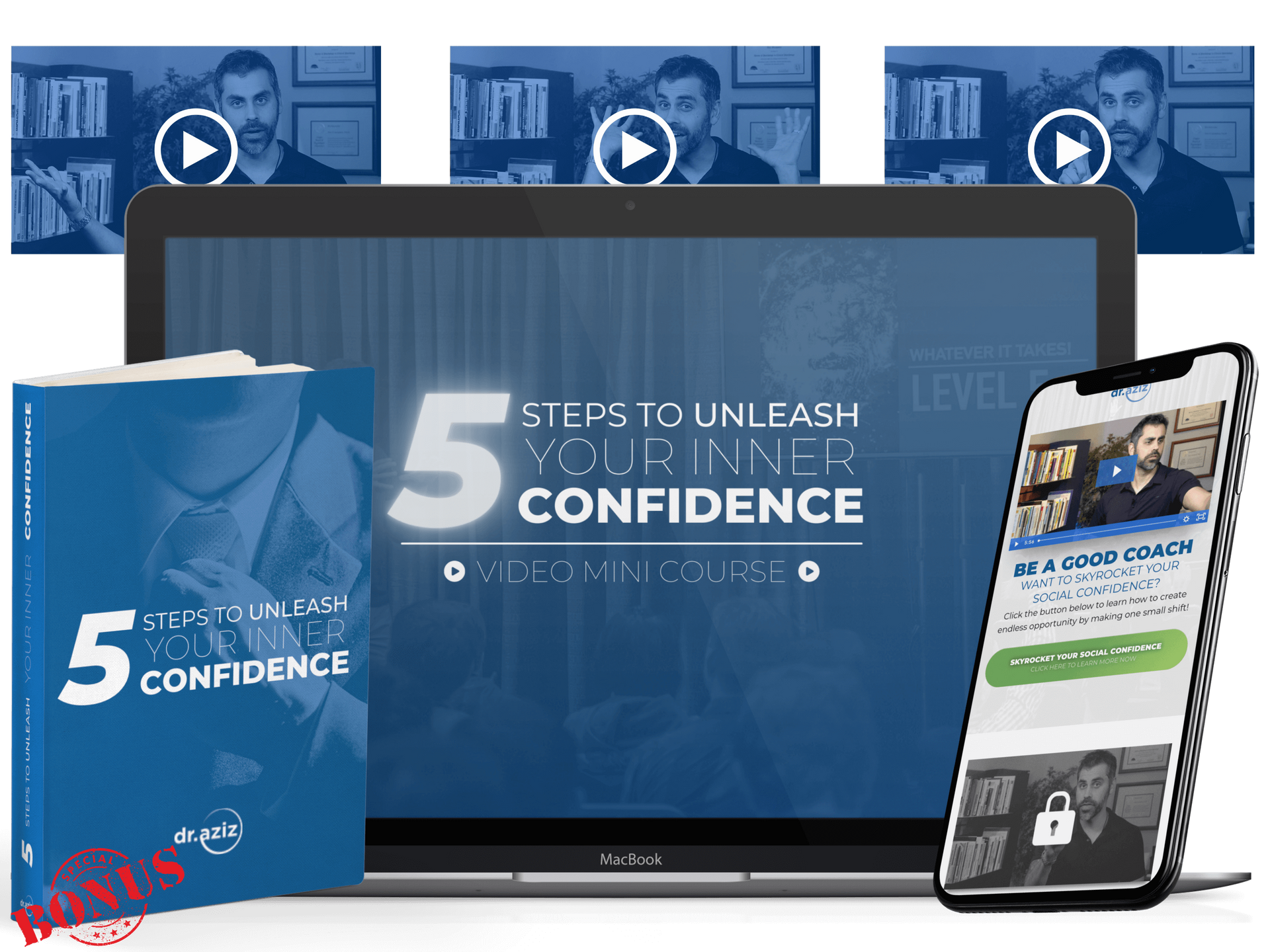
GET YOUR FREE CONFIDENCE MINI-COURSE NOW!
Unleash Your Inner Confidence Today!
Click On The Button Below To Get Your FREE Mini-Course Right Now!
GOT CONFIDENCE?

Confidence University is the culmination of all my years of work assisting others with overcoming social anxiety and building unstoppable confidence in its place. It's the next best thing to work with me one-on-one.