
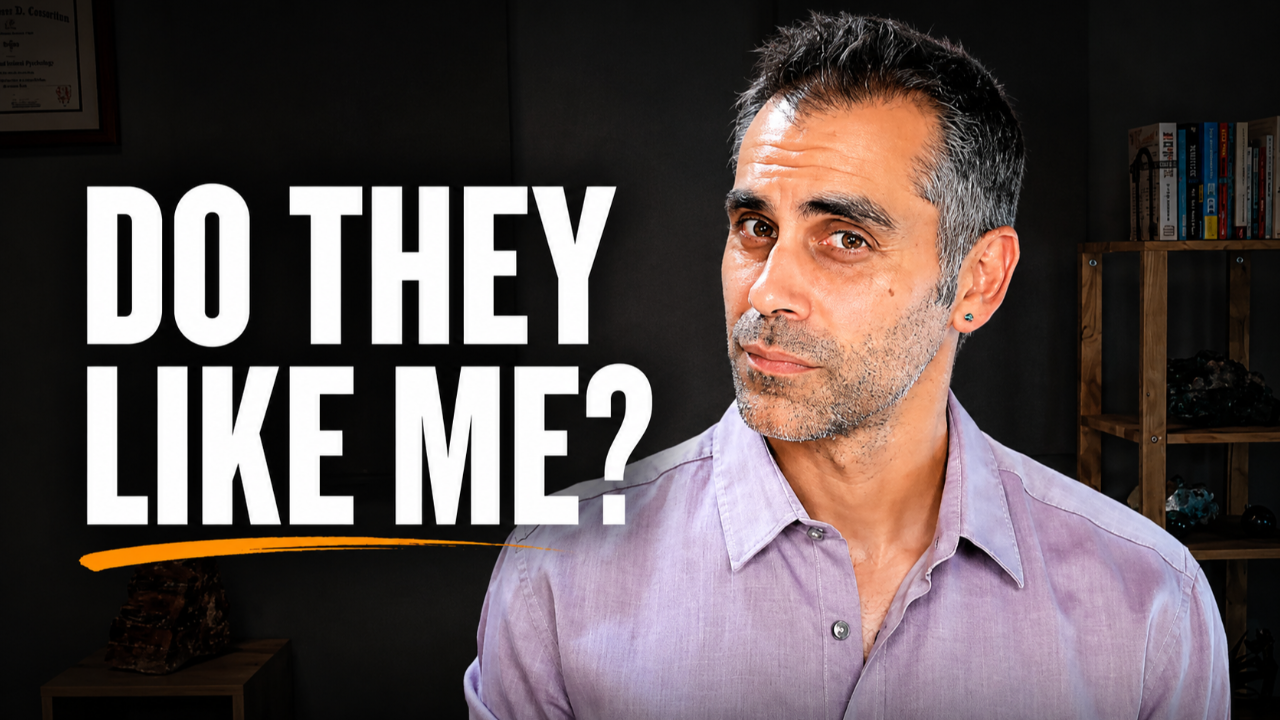
7 Signs You Need People To Like You Too Much
Sep 30, 2026There is nothing wrong with wanting people to like you.
If I introduced you at a party right now and you could walk away with the room liking you or not liking you, pretty much everyone I know would pick liked. That's not a character flaw. That's being a social mammal.
The problem isn't the wanting. The problem is when the wanting quietly becomes needing.
I would like it if they liked me is a preference. It's compatible with being yourself. You can prefer to be liked and still say the thing you actually think. Still hold the boundary. Still deliver the disappointment. The preference doesn't override your access to yourself.
I need them to like me is a different animal. It's a compulsion. And once it's running, everything you do in the presence of the person whose approval you need starts to shift. You perform. You hide. You hold back. You please. You accommodate. You get further and further from who you actually are, in the exact moments where connection would require you to be closer.
Most of the professionals I work with don't recognize themselves in the dramatic version of this pattern. They're not standing at parties visibly craving approval like a four-year-old. They've gotten sophisticated. The compulsion has moved underground, where it runs as a tight stomach, an over-monitored social presence, a set of subtle behavioral tics they don't quite name.
Here are seven signs the pattern may be running. Not the obvious ones. The subtle ones. If more than one or two of these land, it's worth reading to the end.
Sign 1: You Replay Conversations Long After They're Over
Clients often tell me, sometimes a little embarrassed, how long ago the conversation was. Weeks. Months. Sometimes years. Something they said or didn't say in a work meeting or a family dinner or an old friendship is still running in their head.
What's happening in the replay is almost always the same thing. There was something that needed to be said. They needed to defend themselves. Stand up for themselves. Say no. Disagree. Express what they actually thought. They didn't. The conversation is unfinished business, running in the background, because the moment when it could have finished passed and they let it pass.
If you have a handful of these rattling around, you're not being neurotic. You're carrying a set of unresolved moments where the need to be liked overrode the impulse to say what needed to be said.
Sign 2: You Agree When You Actually Disagree
On the outside, you nod. You smile. Maybe you say something noncommittal. Maybe you say nothing at all. Either way, you're implicitly agreeing to a claim you actually disagree with.
The disagreement doesn't disappear. It just moves inside. You leave the conversation and it gets louder. How could they think that? What an idiot. That's completely wrong. Because the disagreement never got voiced, it never had a chance to be examined, softened by the other person's response, or resolved into something more collaborative. It just sits in you as unspoken resentment.
The nice person's disagreement is intense. It just happens after the conversation, not during.
Sign 3: You Over-Explain When a Simple No Would Do
Someone invites you to something you don't want to do. The clean answer is thanks for the invite, I can't make it. Two sentences.
What comes out of your mouth is much longer than that. I'd love to but I have this thing, and my kid has this thing, and I think that weekend we were maybe going to try to, well, let me check and get back to you. By the end, they might not even be sure whether you said no.
The over-explanation is coming from a specific place. It's the internal sense that you don't quite have permission to just decline. That saying no needs to be justified. That your preference alone isn't a legitimate reason. So you build a case. Which means the case-building becomes the thing that stands out, not the no.
Sign 4: You Feel Responsible for Everyone's Mood
I know this one particularly well. It's the version I ran for years.
You walk into a room and immediately start scanning. Is that person okay? Are they enjoying themselves? Did that other person just check out of the conversation? Is anyone feeling left out? The scanning runs constantly, in the background, whether you're at work or at a party or at your own family's Thanksgiving.
Recently, my brother and his family were visiting. I woke up in the morning with a tight stomach. Not because anything was wrong. Because I had already, subconsciously, started running the check. My brother wants to do this. My wife wants to do that. My kids need this. How do I make sure everyone's okay? I was scared. And I was calling it being a good host.
This is the Fixer version of the pattern. It looks like caring. It's actually fear.
Sign 5: You Volunteer for Things You Don't Want to Do
Someone at work needs a volunteer for a committee. Someone in your family needs a ride to the airport. Someone in your friend group needs help moving. Nobody is looking directly at you. But you feel the pull.
If you don't volunteer, it might be uncomfortable. You might sit with the sense that you should have. You might imagine what they'd think of you if you didn't. You might feel the mild guilt of being someone who doesn't step up.
So you step up. And you spend the next week doing something you didn't want to do, quietly resentful, wondering why you keep signing up for things.
Sign 6: One Critical Comment Outweighs a Hundred Compliments
The math is impossible. Ten people said the presentation was great. One person emailed you afterward and said something dismissive. Which one plays in your head for the next three days?
You already know the answer. And the answer defies rational calculation. It's not that you're being dumb about the ratio. It's that your nervous system has categorized the negative signal as a survival threat and the positive signals as background noise. Your body zooms in on the danger. It has to. That's what bodies were built to do.
Which means one criticism can undo the sense of self you spent months building through good work, positive feedback, and the accumulation of small wins.
Sign 7: You Feel Relief, Not Warmth, When You Leave a Social Event
This one is the quietest sign. Which makes it easy to miss.
After a work event, a dinner party, a first date, a family gathering, you walk to your car. Notice how you feel. Is there a warmth? A sense of connection? A glow of having been with people you like?
Or is there a specific feeling of made it through? Relief that it's over. Relief that no one seemed upset. Relief that you performed adequately.
Real connection produces a full feeling. It's warm. It leaves you wanting more of it. The nice version of connection produces relief. It's exhausting. It leaves you wanting to be alone.
If most of your social interactions produce relief instead of warmth, you were performing, not connecting. And you might not have been aware that's what was happening.
What Underneath All Seven
These aren't seven separate problems. They're seven presentations of the same underlying pattern.
Underneath every sign on this list is a nervous system running the equation disapproval equals danger. When disapproval registers as a survival threat, all seven behaviors follow logically. You replay because you didn't defend yourself. You agree because disagreeing would risk disapproval. You over-explain because just saying no might upset them. You manage moods because tension in the room feels like danger to your body. You volunteer because the small guilt of not volunteering is coded as threat. You zoom in on criticism because your body is scanning for threats. You feel relief after social events because relief is what nervous systems feel when a threat passes.
If more than one or two of these signs land, the underlying pattern is running. Which is actually good news. Because it means you don't have seven separate problems to fix. You have one pattern to rewire.
What Actually Shifts It
The specific version of the pattern you're running is one of four. The particulars matter because the shift looks different depending on which one is yours.
Regardless of which of the four, the underlying practice is the same. You have to run enough experiences of risking disapproval and surviving it that your nervous system starts to update. You have to disappoint someone and see that you're okay afterward. Disagree with someone and stay in the room. Say no without the paragraph of explanation. Sit with the fact that the other person's mood is not your responsibility to fix.
Each of those is a datapoint. Enough datapoints, over enough time, and the equation quietly starts to shift.
What Most People Miss
Reading this list and recognizing yourself in most of these signs is not a diagnosis of dysfunction. It's a diagnosis of childhood. Almost everyone who reads this all the way through was wired this way in a specific window of their early life where being liked was genuinely tied to being safe. The wiring made sense then. It stopped serving them decades ago.
The pattern is not permanent. It's a set of learned responses that can be unlearned, in real situations, with practice, over time. The unlearning is slower than we want. It's still real. The version of you underneath the seven signs, the one that isn't organized around being liked, is available. She's just been under the compulsion for a while.
The work is to let her out.
Discover your approval type. Take the 2-minute quiz at www.draziz.com
The specific version of the pattern that produces your particular combination of these seven signs is one of four. You'll find out which is yours, and what shifts when you stop trying to manage the signs and start working with the pattern underneath.
Reading blogs and watching videos online is a start...
When you are ready to radically transform your confidence so you speak up freely, boldly go after what you want, connect easily with others and be 100% unapologetically yourself, coaching is the answer.


GET YOUR FREE CONFIDENCE MINI-COURSE NOW!
Unleash Your Inner Confidence Today!
Click On The Button Below To Get Your FREE Mini-Course Right Now!
GOT CONFIDENCE?

Confidence University is the culmination of all my years of work assisting others with overcoming social anxiety and building unstoppable confidence in its place. It's the next best thing to work with me one-on-one.